

Stage notes!

Metro City is a major Japanese settlement, a bustling center of commerce that enjoys all the benefits the technology of the future has to offer. Situated on Japan’s coastline, Metro City is filled with all sorts of wondrous attractions, ranging from a giant, state-of-the art sports center (where citizens can go watch a pulse-pounding game of rocketball) to a commercial spaceflight facility (where students can go on field trips to get a close-up view of celestial bodies), all of it connected by a cutting-edge series of subways and monorails. It’s also a success story as far as integration with robot life is concerned – the place is kept spic and span by its hard-working robot citizens, and seeing the latest in artificial life walking down the street or selling balloons to kiddies is a common occurrence.

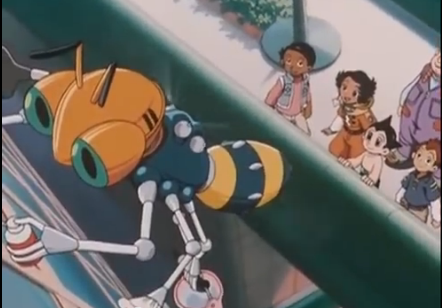
Still, though, accidents are prone to occur, and robots such as the one seen above have been known to go haywire and become hostile towards passerby. It’s a rare happening, and usually attributable to the latest human scoundrel looking to seize power, but for cases where it’s necessary Metro City’s finest are quick on the scene with their electro-mag guns purring, their sirens blaring, and the noses of their dog-shaped cop cars blinking a furious red.

The city’s got something for everyone, with restaurants, schools and public parks to be found wherever you look, and everyone enjoys a high standard of living. And, most importantly, on any given day you might be able to glance up at the sky and see a bare-chested youth zipping by.

In terms of the stage itself, it’s instantaneously recognizable as a Treasure endeavor. Getting dropped in from on high (and getting a glorious view of the skyline and scale of the city), you’re then left to traverse the colorful area while some of the most up-beat intro stage music I’ve ever heard blasts from your crappy GBA speakers. The skyline’s dotted with SEGAs and GUNSTARs, evoking past memories of self-referential billboards (buy your Gunstar Gum today? Dynamite Headdy on sale now!), and everything just comes together to make a really fun experience.
Of note, however, is that stage design is really not this game’s forte – save for a few simplistic mazes, much of the stage traversal is just walking straight, with most of the game’s entertainment value coming from the cast of characters and the super-satisfying combat. The intro stage helps give a taste of that, with introductions to different enemy types (flying, mortars, rockets, stun-resistant), a stoplight enemy to practice dodging, and our first look at the upscaling trick they use to give the enemies some variety. The latter is especially noteworthy in its entertainment value; the devs pull off some really impressive sprites in the game, but they also do this thing where they literally just upscale enemy sprites so that



becomes

and it is amazing. This isn’t even close to being the limits of the up and downscaling done in the game, and some of the more outlandish examples are so over-the-top it becomes absolutely hilarious.
Incidentally, each “chapter” is divided up into sections (generally separated by a black-screen transition), and though we can’t see the names just yet I figure I’ll provide them here.
1 – 1: Metro City; 1 – 2: World Federal Building; 1 – 3: Warehouse Battle; 1 – 4: Spider Robot; 1 – 5: Magnamite.
Boss bios!
Another Treasure staple, the inclusion of a boatload of bosses in every stage, is also coming along for the ride, and though it’s not quite on the level of, say, Alien Soldier, you’re still going to find yourself treated to a new fight against some oversized robotic foe every couple of minutes. These bosses are also most often Astro Boy references themselves, with their own backstory and history, so I’ll be grabbing their sprites, outlining their movesets, and providing any extra info here as well.
Spider-bot 6000

Moveset:
- Spinneret shot: tenses its abdomen, then shoots out four large circular bombs, which proceed to fall to the ground. Two fall to its left, the other two on its right; stand between the shots or directly below the spider-bot to avoid.
- Silk spit: extends its mandibles, then shoots out five small silver balls in a fan pattern below itself. Move away or jet through the shots to avoid.
As if to directly spite my previous statement, the Spider-bot 6000 is just a generic spider robot, so much so that the game specifically refers to it AS the “spider robot”. While it’s true that Astro’s dealt with various insect-like ‘bots through the ages, this particular one has not been featured previously save for a 10-second appearance in the 2003 series where the smaller spider versions go in to conduct maintenance on a power plant. Not exactly a rich history there.
Still, it’s a good introductory boss, not really posing any kind of sizable threat to Astro while at the same time showing him how bosses work.

Fights against the big bads in Astro Boy don’t involve any sort of contact damage, meaning you can nuzzle up nice and close to them to lay the smackdown. You’re not able to overlap sprites, but using Astro’s jets DOES let you travel through (SOME OF) your opponents and come out the other side, allowing a very welcome freedom of movement as you cave in enemy skulls. The amount of health remaining in a boss enemy is also helpfully represented as a series of balls at the bottom of the screen, so you can tell at a glance when to finish them off with a quick arm cannon.
Magnamite
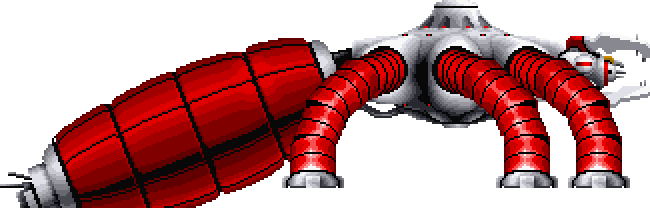
Moveset:
- Overload laser: Used when Astro jumps in front of Magnamite’s face. Opens its “mouthparts”, charges briefly, then fires a laser of pure energy in front of itself. Fall below or ride on its back to avoid.
- Leg swipe: Used when Astro is on top of Magnamite. Charges energy in its front leg, flexes it, then swipes in a circular direction above itself in an attempt to dislodge Astro. Direction of the swipe depends on the way the leg is flexed; jump off Magnamite or boost through the leg to avoid.
- Enrage: Used each time ¼ of its health bar is depleted. Becomes temporarily invincible and crouches up and down rapidly whilst bellowing. Does no damage, but if Astro’s in the middle of an EX attack, the remainder of the damage will not go through.
- Belly flop: Used when Magnamite’s health has been reduced to ¼. Performes enrage, slowly crouches down, then leaps clear off the top of the screen. After a few seconds, Magnamite falls down on Astro’s current location in an attempt to crush him, dealing massive damage (a one-hit KO at this point in the game on hard mode) if he connects. Will then quickly leap into the air again and perform the move ad infinitum until destroyed. The leaps/falls steadily increase in speed as Magnamite’s health decreases; carefully boost out of the way as it falls, then turn around and either Arm cannon or punch Magnamite to death.
2003 appearance picture! See it in action!
Magnamite was the monster of the day in Astro Boy episode 1, much as the rest of the enemies (save for the big-headed robot dudes) also appeared in episode 1. Don’t worry – Metro City’s the only section of the game taken wholesale from the Anime in that regard, with the rest of the game taking their influences from elsewhere.

Normally, Magnamite serves Metro City as the main component in the power plant that services the entirety of the populace, guiding and controlling current to private residences and major businesses alike. Unfortunately, due to a mysterious man’s sabotage, Magnamite is overloaded when all power is directed to the Ministry of Science in an attempt to awaken a comatose Astro, which ultimately results in it going haywire. It’s not evil, so to speak, and ultimately gets defeated when Astro lets it discharge its excess power into his own body, but it doesn’t go down without tearing up a good chunk of the city first.
As far as the fight against it goes, I’d normally describe this guy as a wake-up call boss…except for the fact that he appears in the first stage. Astro Boy: Omega factor doesn’t really pull its punches at any point, and Magnamite can and will wreck you thoroughly if you let it.
Bosses in this game often don’t really have that large a moveset, but their moves cover large swaths of area and do tons of damage when they DO connect, which means careful positioning is a must. Magnamite’s a good intro to that, as attempting to Arm Cannon it in the face will just cause it to respond with a blast of its own, and I can guarantee that you will end up on the losing side of that exchange. Moreover, his desperation attack is an absolute beast and basically necessitates rapid and skillful use of your boost in order to finally land the killing blow. Not a walk in the park by any means.
Still, Omega Factor’s fairly lenient in that death merely means your score gets reset before you get dropped right back into the fray, so with practice you’ll take this thing down without too much hassle.
Oh, and if you’re wondering – MagnEmite’s the Pokemon, MagnAmite’s this boss. No jokes allowed.
Music!
Another bunch of music here, this time with some real gems. The prechapter jingle’s got this weird distorted voice saying “ASTRO BOY” and it’s bizarre and I love it, Metro City’s oozing with personality, and the two boss themes are great. The midboss one, in particular, is notable for being partially reused in Treasure’s 2005 game “Gunstar Super Heroes”, in the intro of the “Smash” track. I’ll link to it below as well for comparison purposes.
#6: Prechapter jingle
#7: Metro city
#8: Conversation
#9: Boss theme 1 – Midboss/Comparison Smash
#10: Boss theme 2 – Magnamite
#11: Stage complete fanfare