Viper of Mino - Poems and Motonari Mori’s Schemes - Update 9
A simple and small update. We learn a bit about the history of Japan’s schooling as well as the poems to live life by, and see Motonari aging and becoming even more of a schemer.
After Tadayoshi Shimazu became a monk, he changed his name to Jisshinsai Shimazu. Praised as “The Sacred Ruler of Satsuma”, Jisshinsai was said to be both wise and virtuous. Additionally, he was als famous for teaching that same wisdom and virtue equally to his followers.
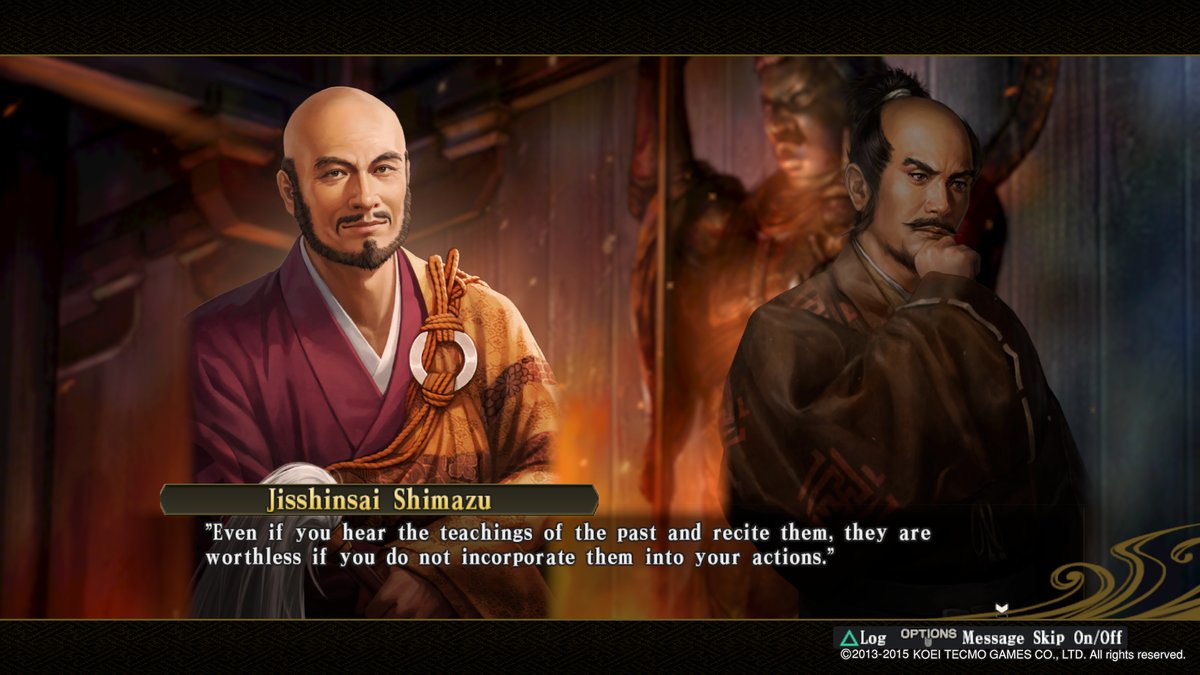
Jisshinsai Shimazu:
“Even if you hear the teachings of the past and recite them, they are worthless if you do not incorporate them into your actions.”
Takahisa Shimazu:
Indeed.
Jisshinsai Shimazu:
“No matter whether you live in an ornate mansion or a straw hut, a person’s virtue is determined by what is in their heart.”
Takahisa Shimazu:
I see.
Jisshinsai Shimazu:
“Can we rely on such a fleeting thing as ‘tomorrow’? ‘Today’ is when your studies must be done.”
Takahisa Shimazu:
I agree completely.
Jisshinsai Shimazu:
…Do you really understand what I’m saying? I can’t tell with such halfhearted responses.
Takahisa Shimazu:
Sorry, I’m a man of few words. I may not even live up to the hair on your feet, but these poems you wrote are easy to understand even for me. You are truly a wonderful teacher, Father.
Jisshinsai Shimazu:
Well, I thought it would be good for you to learn some things. Studying isn’t only for monks you know. Someday, all the people of Satsuma must study and nourish their minds.
Takahisa Shimazu:
“Even if you think yourself to be unskilled, do not slack off. Your training is the proverbial ‘journey of a thousand miles’.” Well said.
Jisshinsai Shimazu:
“Before you legislate, educate. Punishing someone who is ignorant of their crime…is not a vrtuous path.”
Takahisa Shimazu:
I shall carve that into my very being.
There are forty-seven “Iroha Poems” that Jisshinsai wrote, one for each of the characters of the Japanese syllabary. Each poem starts with a different character. Jisshinsai’s poems expound a sort of model for warriors to follow in their daily lives, based on his wisdom. The Iroha Poems would go on to serve as the foundation for Satsuma’s Goju education system. Later, during the Meiji Restoration, they would also contribute greatly to the education of the people of Satsuma.
The Kobayakawa clan of the Sanyo region boasted a powerful navy. The clan had weakened in recent years as a result of a series of deaths of the clan heads, but Motonari Mori and Yoshitaka Ouchi had begun a maneuver to restore the Kobayakawa clan to its former glory. With support from Yoshitaka, Motonari’s third son, Takakage, changed his name and became the next head of the Kobayakawa clan.
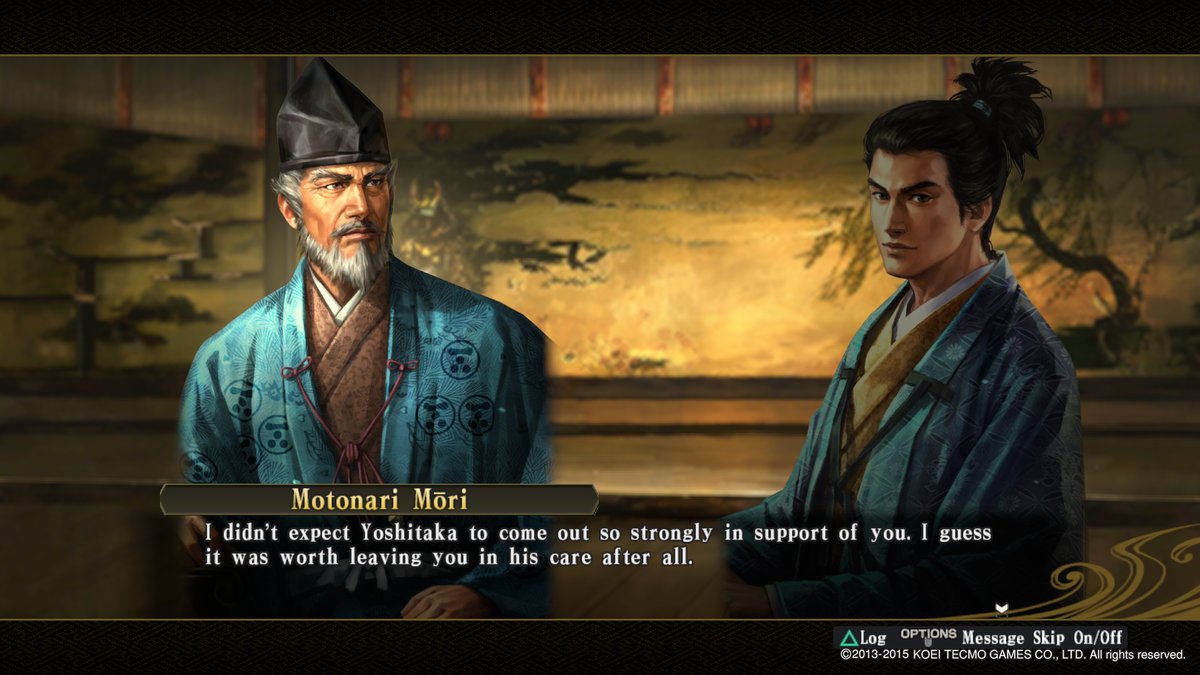
Motonari Mori:
I didn’t expect Yoshitaka to come out so strongly in support of you, I guess it was worth leaving you in his care after all.
Takakage Kobayakawa:
Yes… We must use whatever methods we have available to us.
Motonari Mori:
Indeed. Your talents as a leader are unmatched by both Takamoto and Motoharu. I’m entrusting the Kobayakawa clan to you because I have faith in you. Do you get my meaning? Do not disappoint me.
Takakage Kobayakawa:
Heh… Leave it to me. I wll use the power of the Kobayakawa clan to the fullest in supporting the Mori clan.
Motonari Mori:
Also…
Takakage Kobayakawa:
Yes?
Motonari Mori:
Be careful of flattery. Don’t let our enemies win you over.
Takakage Kobayakawa:
…Understood.
The Kobayakawa clan was in possession of a powerful navy, and gaining control of this held great meaning for the Mori clan. And so, Takakage Mori changed his name to Takakage Kobayakawa, and was put in charge of expanding Mori influence n the Sanyo region.